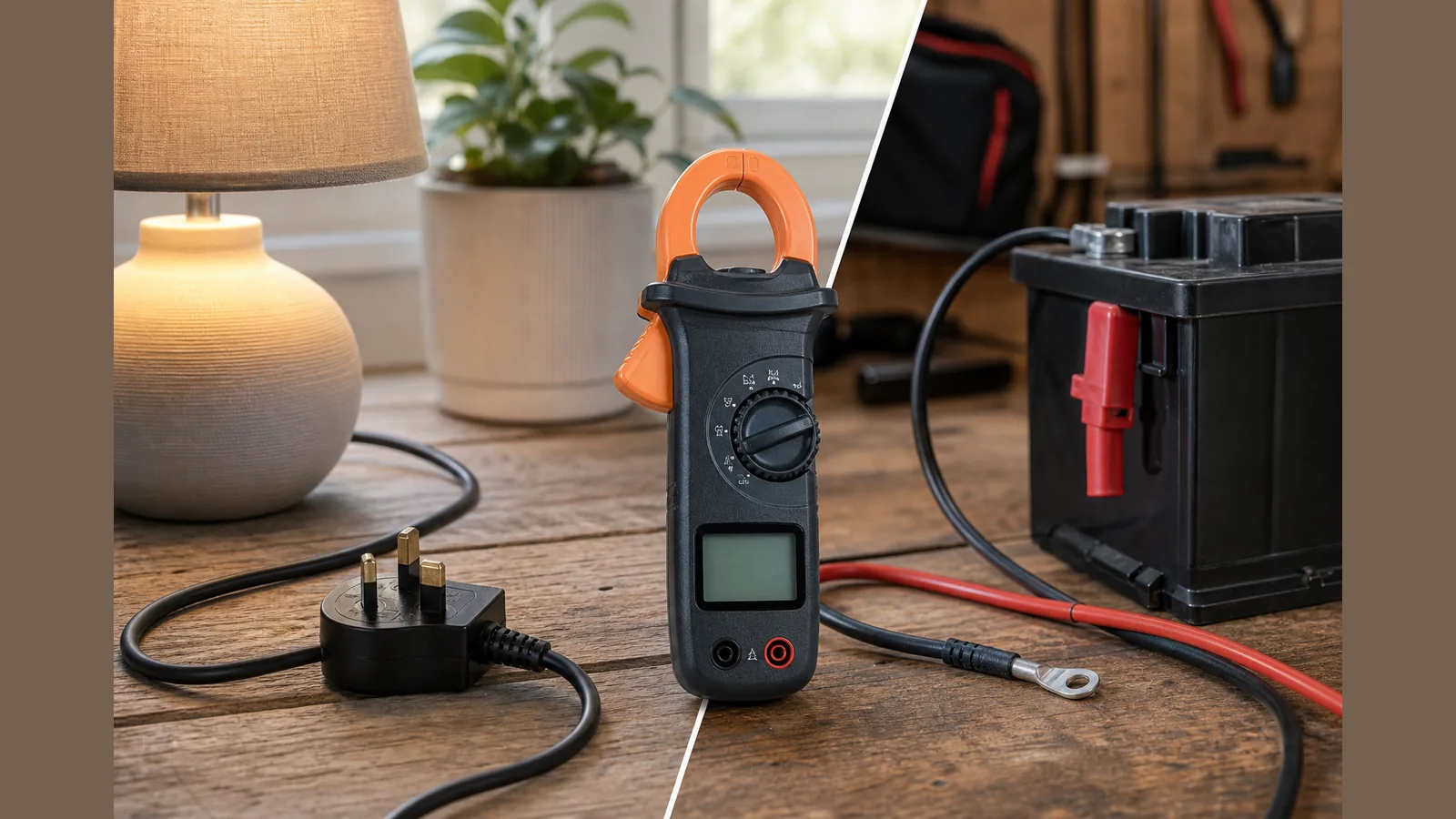
AC-Only vs AC/DC Clamp Meter UK: Which Do You Actually Need?
For ac only vs ac dc clamp meter uk buyers, an AC-only clamp is fine for many 230 V circuit checks, but it cannot read vehicle, leisure-battery or other DC currents—so if those jobs appear on your list, you need an AC/DC clamp (Hall-effect style) rather than an inductive AC-only jaw.
Answer: AC-only misses vehicle, leisure battery and many DC screens
An AC-only clamp senses alternating current through the magnetic field around a live conductor. It will not measure steady DC, which is exactly what you meet on cars, vans, boats, caravans, solar battery banks and many low-voltage DC supplies.
An AC/DC current clamp meter measures both alternating and direct current without breaking the circuit, which is why UK automotive technicians chasing a parasitic draw treat it as the practical tool for that work.
UK electrician-facing guides also stress the AC versus DC distinction, accuracy limits and how inductive and Hall-effect clamps differ in everyday use.
Use-cases that need DC milliamp capability
Choose AC/DC (with a usable low-current / milliamp range where the meter offers one) when you need to:
- Trace parasitic battery drain on vehicles or plant without opening the circuit for a series ammeter on every check.
- Check leisure, marine or off-grid battery loads and charging-related current on DC conductors.
- Confirm current on individual DC feeds where opening the cable is awkward or unsafe for the task.
Specialist UK suppliers stock AC/DC clamps from established test brands specifically so you can measure current in a conductor or individual circuit without interruption—useful whenever DC is part of the job mix.
When AC-only is enough
An AC-only clamp remains a sensible buy if your work stays on mains AC distribution: spotting loaded circuits, comparing branch currents, or rough load checks on single conductors where you only need alternating current.
If you never touch vehicle electrics, battery systems or other DC runs, paying for DC capability may add little day-to-day value. Keep the decision tied to the circuits you actually meet, not to marketing labels.
True RMS still matters on distorted AC loads
On non-sinusoidal AC—variable-speed drives, LED drivers, IT loads and similar—average-responding meters can mis-read. True RMS helps the AC reading stay meaningful when the waveform is distorted.
If you already need AC/DC for battery or vehicle work, True RMS on the AC side is still worth checking on the live specification, especially under £100 where feature sets vary by model. Do not treat True RMS as a substitute for DC sensing: they solve different problems.
Jaw size and competence caveats
Jaw opening must fit the cable or bundled conductor you intend to clamp; a jaw that will not close cleanly on the target is useless on site. Clamp one conductor at a time for a meaningful current reading.
Treat electrical work under competent-person practice and safe isolation. Non-contact voltage indication (sometimes labelled V-Alert or NCV) is a convenience cue only—it is not prove-dead. Confirm isolation with the correct proving procedure before you touch conductors.
Buying checklist without inventing CAT ratings
Use this short list; verify category markings, ranges and kit contents on the live product page and on the meter itself before you buy or use it:
- AC only, or AC plus DC (and whether low-current / mA DC is offered).
- True RMS behaviour on AC if your loads are likely distorted.
- Jaw size against the cables you clamp most often.
- Display, hold and any DC-zero / relative function that helps small DC readings—confirm on the live listing.
- Measurement-category markings: only trust what is printed on the instrument and stated on the current product page; do not assume a rating from a blog.
Avoid duplicating generic “buyers’ guide” or safety-checklist pages you already publish; keep this page focused on the AC-only versus AC/DC decision.
CTA to ACM92 detail page
If your mix includes DC draw, leisure batteries or similar work as well as AC checks, review the BSIDE ACM92 True RMS DC current clamp / multimeter positioning on our site. For live kit contents, price and specifications, see the ACM92 True RMS DC current clamp meter product details.