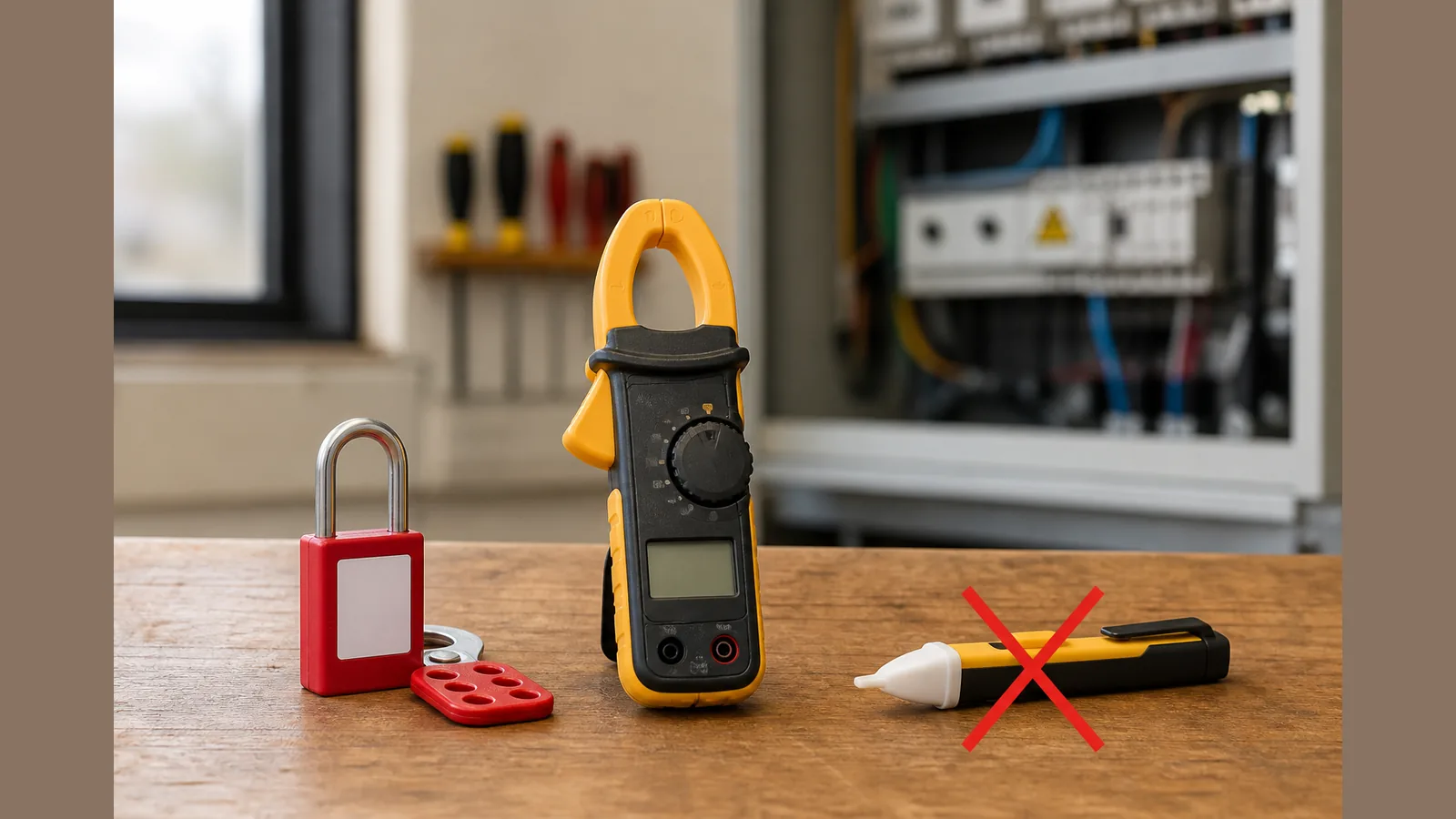
Prove-Dead vs NCV/V-Alert Honesty UK: What a Clamp Screen Is Not
In the UK, an NCV or V-Alert indication on a clamp meter is a useful screening cue, not a prove-dead method: it does not replace safe isolation, competence checks, or a proper dead-test sequence before you treat a circuit as safe to work on.
Direct answer: V-Alert/NCV is a screen, not a prove-dead method
Non-contact voltage (NCV) or V-Alert functions detect electric fields near live conductors. A beep, light, or screen icon may warn that something nearby could be live. That is screening information only.
Prove-dead means confirming a conductor is dead through an isolation and verification process appropriate to the work, carried out by someone competent for that task. An NCV tip near a cable does not prove absence of voltage, does not confirm isolation, and does not stand in for testing between conductors and earth with suitable equipment and a known-good proving routine.
Electrical test meters sit between you and the hazard of live circuits; using them honestly means matching the tool’s indication to what it can actually establish, not treating a screen alert as a full safety clearance.
HSE-framed competence and isolation expectations
HSE guidance on electrical inspection and testing frames responsibilities and competence expectations for electrical work: people must be competent for the tasks they undertake, and inspection or testing must sit within controlled, planned work rather than improvisation.
HSE also covers risk control for diagnostic testing, fault finding and quality-assurance tests on electrical equipment. That framing matters for prove-dead honesty: if you are diagnosing, proving isolation, or working on or near electrical equipment, control measures, method and competence come first. A clamp meter’s NCV/V-Alert mode may support awareness during screening; it does not finish the risk-control job on its own.
What NCV can and cannot tell you
What NCV/V-Alert can help with
- Flagging that a conductor, junction box or cable run may be energised before you dig deeper.
- Prompting you to stop, reassess isolation and switch to contact measurement or a formal prove-dead process when the work requires it.
- Reducing casual “it looks off” assumptions when a live indication appears during a walk-round screen.
What it cannot establish
- That a circuit is isolated and locked off.
- That every phase and neutral path is dead under load or fault conditions.
- That protective devices have operated as expected, or that parallel feeds are absent.
- That it is safe to cut, strip or reconnect without further verification.
False confidence is the honesty problem: a quiet NCV mode can miss screened or weakly coupled conductors; a loud alert can also be environmental noise. Either way, treat the result as a prompt, not a certificate of safety.
GS38-minded lead/probe habits without inventing CAT numbers
When work moves from screening to contact measurement, habits matter more than brand claims. Keep leads and probes in good condition, use them only for the measurements they are intended for, and avoid improvised or damaged accessories. Follow a prove-dead mindset: check the instrument on a known source before and after testing where that practice applies to your method, verify the correct points, and do not rely on a single ambiguous reading.
Do not assume a category rating, accuracy percentage or accessory rating from marketing copy alone. Confirm markings, kit contents and suitability on the live product information before you buy or rely on a meter for a given task. For current clamp use, remember that jaw-based current indication and NCV screening answer different questions; neither replaces isolation verification when the job demands prove-dead.
Homeowner vs competent person boundary
Homeowners may use NCV/V-Alert as a cautionary screen—for example noticing an unexpected live indication and stepping back. That is awareness, not authorisation to open consumer units, alter fixed wiring, or declare a circuit dead.
Competent-person testing in the UK sits with people who understand isolation, residual hazards, and the limits of each instrument mode. If you are not competent for the work, stop at screening and call someone who is. Honesty about prove-dead versus NCV protects both DIY curiosity and professional practice: the tool does not redefine who should do the job.
FAQ and next step
Is V-Alert the same as prove-dead?
No. V-Alert/NCV is a non-contact screen. Prove-dead is a verification process after isolation, carried out with competence and suitable methods.
Can I use NCV instead of safe isolation?
No. Screening versus safe isolation are different steps. HSE-framed expectations still point to competence, control of risk and proper testing practice for work on electrical equipment.
Where should I check kit details for a DC current clamp with True RMS positioning?
Check the live product page for current specifications, accessories and pricing rather than relying on secondary summaries. If you are comparing a compact DC current clamp / True RMS multimeter option such as the BSIDE ACM92 positioning offered on this site, review the current ACM92 True RMS DC current clamp meter details before you decide—and keep NCV/V-Alert firmly in the “screen only” column of your mental checklist.