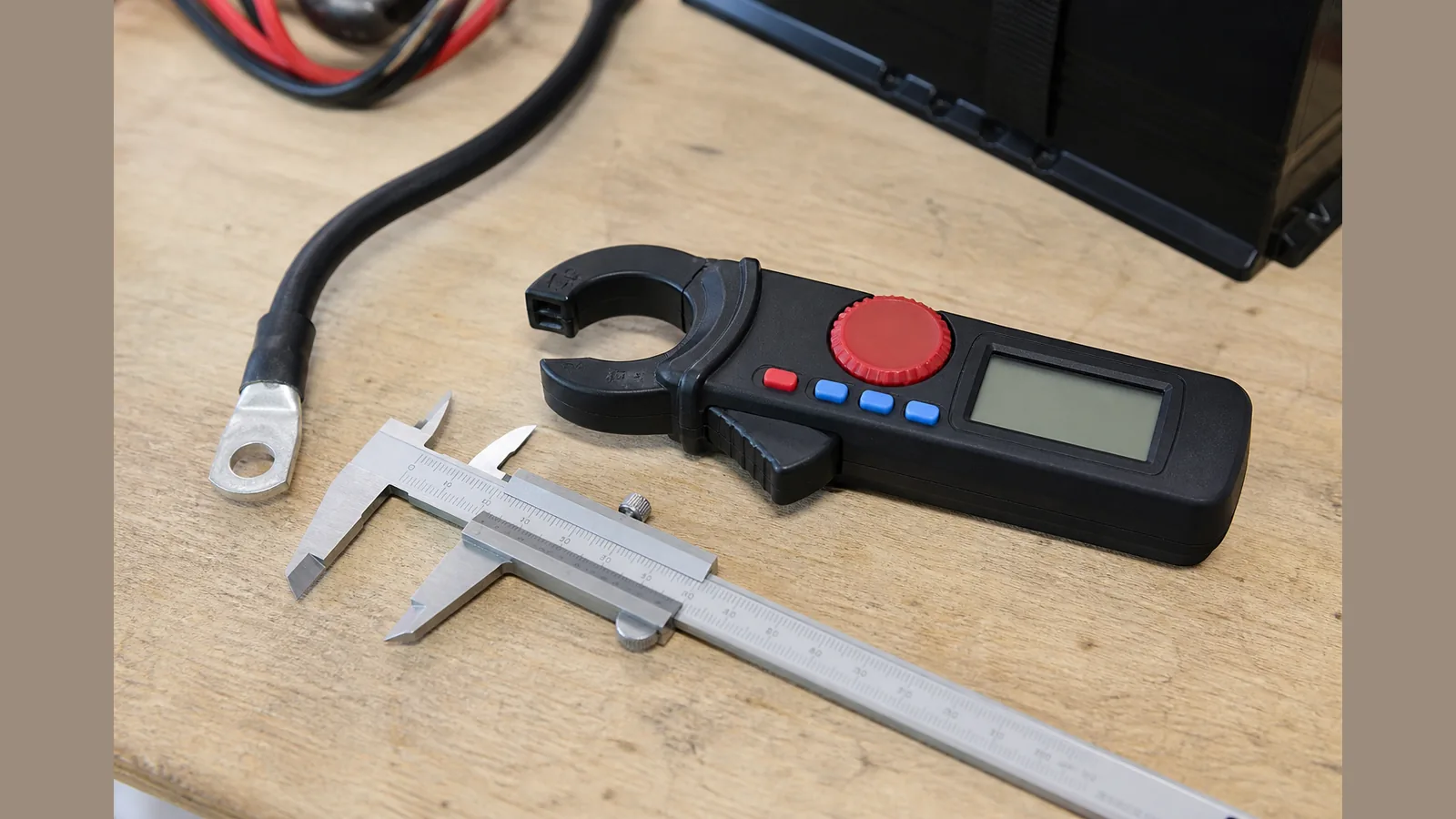
will 20mm jaw fit leisure battery cable
Answer: measure OD before you promise the job
Whether a 20mm jaw will fit a leisure battery cable depends on the cable’s outside diameter (OD) and how much clearance you have around it—not on guesswork from the battery rating alone. Measure the insulated OD of the single conductor you need to clamp, then compare that figure with the meter’s stated jaw opening before you commit to the job or the tool.
Leisure and starter leads are often thicker than everyday appliance flex, and bundling, heat-shrink or double insulation can push the OD past a compact jaw even when the copper cross-section looks modest on paper.
How to check leisure/starter cable diameter safely
Work only if you are competent for the system involved, and follow safe-isolation practice. Non-contact voltage indication is not a prove-dead method.
- With the circuit isolated and confirmed safe to approach, select the exact cable you intend to measure—one conductor only, not a pair taped together.
- Use a calliper or a simple diameter gauge on the insulation OD at the point where the clamp must close; note any boots, sleeving or terminal shrouds that sit in the same path.
- Allow a little spare clearance so the jaws can close fully without forcing the cable or the hinge.
- If you cannot isolate safely, stop and use a hire kit or a larger clamp suited to the access and conductor size rather than improvising.
When a compact jaw loses to hire/larger clamp
Rigid, larger-jaw clamp meters remain the usual choice when you need stable, repeatable readings on conductors that still fit the opening and are reasonably spaced. Guidance on jaw selection notes that rigid large-jaw designs are prioritised for accuracy, stability and repeatability when conductors are manageable in size and spacing.
Where the cable OD approaches or exceeds a compact opening, or where you need headroom around thick battery leads, a larger jaw helps. For example, some digital clamp meters used for installation and inspection work offer jaws sized for cables up to 27 mm in diameter. If your leisure lead sits in that thicker band, hire or borrow a larger clamp rather than forcing a 20mm-class tool.
Crowded battery bay single-cable access
Fit is not only about diameter. Battery bays in vans, caravans and boats are often tight, with short free length between the terminal and the next cable or tray edge.
In those spots, a thinner or more manoeuvrable jaw can help you reach a single conductor and still see the display—detachable or slim-jaw designs are marketed for easier access in awkward wiring. That access advantage still fails if the OD itself is larger than the jaw can close around, so measure first, then judge clearance.
Honesty about ACM92 20mm class jaws
The BSIDE ACM92 is positioned as a DC current clamp / True RMS multimeter with a compact, roughly 20mm-class jaw. Treat that figure as a hard physical limit: if the insulated OD plus needed clearance is greater than the opening, it will not fit, and no display feature changes that.
Do not assume CAT/IEC category ratings, kit contents or accuracy figures from marketing copy alone—check the live product page and the markings on the meter you hold. For current jaw-capacity wording, contents and live pricing, use the product detail page rather than this article.
CTA to product page for jaw capacity copy
If your measured single-cable OD and bay access look suitable for a compact 20mm-class jaw, review the live jaw-capacity copy, specifications and kit list on the ACM92 True RMS DC current clamp meter product page before you buy.